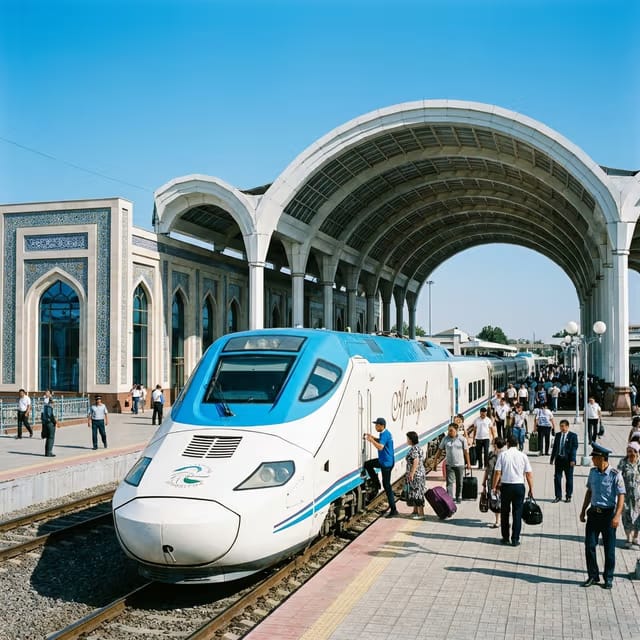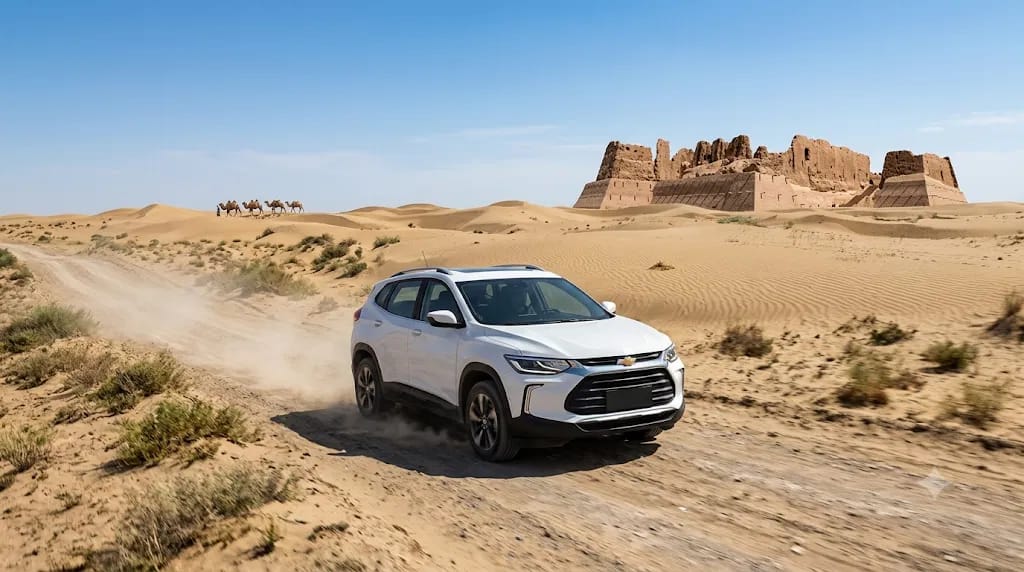
The Bukhara–Khiva drive is 522 km across the Kyzylkum Desert and takes 6.5 to 7.5 hours. A private transfer is the only comfortable way to do it — here's everything you need to know before you book.
The drive from Bukhara to Khiva is 522 km across the flat, rust-coloured expanse of the Kyzylkum Desert. Expect 6.5 to 7.5 hours in the car depending on the season and road conditions. There is no direct train and no comfortable bus. A private transfer is how most independent travelers make this journey — and it is not hard to see why once you are moving through the desert at sunrise.
This guide covers the route honestly: what the road is actually like, what to expect at the destination, how the pricing works, and the smart stops to break up the drive.
Bukhara to Khiva Private Transfer: The Basics
Distance: 522 km Drive time: 4.5–5.5 hours (allow a little more in summer) Road: Mostly paved two-lane highway via the A380 corridor; the section through the Khorezm region narrows and requires patience Best departure time: 6:30–8:00 AM — you arrive in Khiva with time to see Itchan Kala in the afternoon light
TourFixer runs this route with four vehicle options:
| Vehicle | Capacity | Fixed Price |
|---|---|---|
| Economy Sedan | up to 3 passengers | from $120 |
| Comfort SUV | up to 3 passengers | from $155 |
| Minivan | up to 7 passengers | from $215 |
| Bus / Sprinter | 8+ passengers | from $250 |
Prices are fixed — no fuel surcharges, no surprises at the end of the ride. You pay a deposit to confirm the booking, then settle the balance with the driver on arrival.
Book your Bukhara to Khiva transfer and get a WhatsApp confirmation within 60 minutes.
Most Popular
from $100
Book Your Bukhara–Khiva Transfer Today
Fixed price, vetted driver, door-to-door pickup. Deposit to confirm — pay the rest on arrival. We reply via WhatsApp within 1 hour.
What the Drive Is Actually Like
People picture the Kyzylkum as endless dunes. The reality is more subtle — wide, open semi-desert with low saxaul scrub and the occasional camel herd wandering close to the road. It is not dramatic the way the Sahara is dramatic, but there is a real quietness to it that most travelers find unexpectedly calming.
The road out of Bukhara is good. The stretch toward Navoi is straight and fast. After that, you cross into the Khorezm region and the landscape starts to feel distinctly different — flatter, more agricultural at the edges, and the mud-brick villages begin hinting at what is ahead. The final approach into Khiva along the canal road is one of the better arrival moments in Uzbekistan.
Sometimes there are police checkpoints. Your driver handles all of that — just have your passport within reach. It adds maybe 5 minutes.
Up to 30 minutes of stops are included in your transfer at no extra charge. Most drivers know a decent roadside café roughly halfway where the lagman is hot and the tea comes fast. It is worth the break.
If you want to detour through the Ayaz-Kala or Toprak-Kala desert fortresses before arriving in Khiva, that is possible — mention it when booking and we will factor in the extra time and any adjusted cost.
The Desert Fortresses: What You Can Actually See En Route
The region between the Kyzylkum and Amu Darya is sometimes called the land of forgotten kingdoms. The ancient fortresses — called kala in Uzbek — are the ruins of Khorezmian citadels that predate Islam in Central Asia. Some are worth a real stop; others are more atmospheric from a distance.
Ayaz-Kala is the one that photographs best. Two interconnected fortresses sit on a rocky ridge about 25 km north of the main highway. From the top of the lower fort, you can see the full sweep of the Kyzylkum stretching south. The climb takes about 20 minutes.
Toprak-Kala ("earthen fortress") is slightly larger and more excavated, with a partial museum on site. It is a little further off the main route but accessible if you leave Bukhara early.
Koy-Krylgan-Kala is a circular Zoroastrian temple that most tour groups skip entirely. The structure is ancient — some archaeologists date it to the 4th century BC — and the site has an eerie stillness.
If you want to properly explore these sites, consider hiring a licensed guide in Khiva who specializes in the Khorezm region. The context matters enormously — find a Khiva guide here.
For a complete driving itinerary that strings these fortresses into a single-day loop, see our guide to the Bukhara–Khiva road trip stops.
Local Expertise
Planning to Explore the Desert Fortresses?
Add a licensed Khiva guide on arrival — they know which towers are worth climbing and when the light hits the mud walls best.
Arriving in Khiva: What to Know Before You Get There
Khiva is a city that surprises people. Most photos show Itchan Kala — the inner walled city — glowing in late-afternoon light, and it really does look like that. What the photos do not show is how compact everything is. The whole UNESCO-listed inner city takes about 20 minutes to walk across.
Your driver will drop you at your hotel inside or just outside the old city walls. Hotels inside Itchan Kala have narrow access lanes; let us know where you are staying when you book and we will coordinate the exact drop-off point.
A few things worth knowing:
- The entry ticket to Itchan Kala covers most of the inner city attractions
- The Islam Khodja minaret is best climbed in the morning before tour groups arrive
- The carpet workshops in the outer city (Dichan Kala) are worth an hour if you are interested in textiles
- Khiva is genuinely walkable in a way that Samarkand or Bukhara are not
If you are continuing to Nukus from Khiva, that is another journey worth planning in advance — read our Khiva to Nukus transfer guide for honest timing and prices.
Practical Tips for the Bukhara–Khiva Drive in 2026
Best time of year: April–June and September–October. The desert in July and August is brutal — temperatures exceed 40°C and the car's A/C will be working hard the entire way. Winter (December–February) is cold but road conditions are generally fine.
Night or day? Always daytime. There is no rail alternative and driving the Khorezm highway at night is not something experienced drivers recommend.
What to bring in the car:
- A refillable water bottle (fill it before you leave Bukhara)
- Snacks for the road — options are sparse between the main towns
- A light layer even in summer; the A/C gets cold on a long drive
- Your passport (checkpoints require it)
Photography: The light in the desert is best in the first 2 hours of the drive. The saxaul flats and distant plateau edges photograph well with a wide lens around 7–9 AM.
Cash: Carry some Uzbek sum for roadside stops. Card machines outside Bukhara and Khiva are unreliable. For more on managing money in Uzbekistan, the Uzbekistan money and ATM guide covers what you need.
If you are building a wider itinerary — Tashkent, Samarkand, Bukhara, Khiva — the 7-day Uzbekistan itinerary maps it all out day by day.
4 Vehicle Options
from $100
Solo, Couple, or Group — There's a Vehicle for You
Sedan from $100 · SUV $155 · Minivan $215 · Group Bus $250. No surprises at the end of the ride. Deposit to secure, settle the rest when you arrive.
Why a Private Transfer and Not a Shared Taxi or Bus?
The shared taxi from Bukhara to Khiva technically exists. You find a car from the local taxi rank, negotiate, possibly wait 90 minutes for the car to fill, and share the vehicle with strangers on a long desert crossing. Drivers push to reach Khiva quickly and rest stops are at their discretion.
The marshrutka (shared minibus) option is cheaper but the journey can stretch past 9 hours, the vehicles are inconsistently maintained, and if something goes wrong on a desert highway your options are limited.
With a private transfer:
- The departure time is yours
- The A/C is yours to control
- Up to 30 minutes of stops are yours to use as you like
- The driver is vetted and rated by previous passengers
- The price is fixed before you leave — no renegotiation mid-desert
For groups of 3 or more, a private sedan at from $100 often works out cheaper per head than most shared taxi deals once you account for the flexibility and comfort.
Frequently Asked Questions
See the FAQ section below for answers to the most common questions about this route.
Frequently Asked Questions
How long does the drive from Bukhara to Khiva take?
The drive is 522 km and takes 6.5 to 7.5 hours depending on road conditions and the season. Allow a little more time in summer when rest stops are necessary. Departing by 7 AM from Bukhara typically gets you to Khiva by early to mid-afternoon.
Is there a train from Bukhara to Khiva?
There is no direct train between Bukhara and Khiva. The closest train station to Khiva is in Urgench, about 35 km away, and connections from Bukhara to Urgench by rail are indirect and time-consuming. Most travelers find a private car transfer the most practical option.
How much does a private transfer from Bukhara to Khiva cost?
TourFixer charges $100 for an economy sedan (up to 3 passengers), $155 for a Comfort SUV, $215 for a minivan (up to 7 passengers), and $250 for a group bus or Sprinter. All prices are fixed with no surcharges. A deposit is required to confirm the booking; the balance is settled with the driver on arrival.
Can I stop at the desert fortresses on the way to Khiva?
Yes. Stops of up to 30 minutes are included free of charge. For longer detours to sites like Ayaz-Kala or Toprak-Kala, let us know when booking so we can plan the timing and confirm any adjusted cost based on the extra distance.
What is the best time to make this drive?
April to June and September to October are the best months. Summer (July–August) temperatures exceed 40°C and while the car is air-conditioned, rest stops become more frequent. The drive is always done in daylight.
Do I need to pay in full before the trip?
No — you pay a deposit to secure the booking and confirm your slot. The remaining balance is paid to the driver directly on the day of travel. TourFixer does not require full prepayment./