Быстрые ответы
What are the desert fortresses of Khorezm?
They are ancient fortified sites in the Ellik-Kala region of Karakalpakstan, built by the Khorezm civilisation over roughly a thousand years. The best known are Ayaz Kala, Toprak Kala and Kyzyl Kala.
How do I get to Ayaz Kala, Toprak Kala and Kyzyl Kala from Khiva?
The practical way is a private car and driver on a full-day trip from Khiva. There is no public transport to the sites, and the final stretch is on desert roads.
How long does the fortress day trip take?
Plan on a full day. The sites are far from Khiva and from each other, so a large part of the day is the drive. We confirm the start time when you book.
Which fortress is the best one to see if I only have time for one?
Toprak Kala is the most important historically, with the layout of a royal palace city. Ayaz Kala has the most dramatic setting, and Kyzyl Kala is the most photogenic. The day trip combines all three.
На этой странице
- 01What was Khorezm, and why does it matter?
- 02Ellik-Kala: the land of fifty fortresses
- 03Toprak Kala: the royal palace in the sand
- 04Kyzyl Kala: the “Red Fortress”
- 05Ayaz Kala: three fortresses and a sunset
- 06How the day trip from Khiva works
- 07When is the best time to go?
- 08What to bring and how to avoid the common mistakes
- 09Can you get there without a private driver?
- 10How to combine the fortresses with the rest of your trip
- 11How much does it cost?
Two hours from the tiled domes of Khiva, the green oasis simply stops. Beyond the last canal there is only sand, scrub and sky, and on the horizon, something that does not belong to the desert at all: a wall. Then a tower. Then a whole mud-brick fortress, three or four storeys of it, still standing after roughly two thousand years.
These are the desert fortresses of Khorezm, and they are one of the best-kept secrets of Uzbekistan. They sit in the Ellik-Kala region of Karakalpakstan, on the far side of the Amu Darya from Khiva, and most visitors to Uzbekistan never see them. You will often be the only people there.
This guide is the complete, honest introduction to the three best-known sites: Ayaz Kala, Toprak Kala and Kyzyl Kala. You will learn who built them and why, what each one is actually like to visit, how to fit them into a day from Khiva, when to go, what to bring, what it costs, and the mistakes that spoil the trip. If you just want to book, you can see the private day trip from Khiva at any point.
What was Khorezm, and why does it matter?
Khorezm (also written Khwarazm or Khorasmia) is one of the oldest civilisations of Central Asia. It grew in the delta of the Amu Darya, where the river spreads out and makes farming possible in the middle of a desert. For well over two thousand years, people here dug canals, grew crops and built cities, and each time the climate or the politics changed, they moved the cities and built new ones.
A few things to hold on to as you read:
- It is ancient. Khorezm appears in the records of the Persian Achaemenid empire, and local tradition connects it with the early Zoroastrian world. The fortresses in this guide belong to the long period before and after the start of our era.
- It was a land of scholars. The medieval scientists al-Khwarizmi, whose name gave us the word algorithm, and al-Biruni, one of the great polymaths of the Islamic world, both came from Khorezm.
- It was destroyed and rebuilt, several times. The Arab conquests, the Mongol invasion of the early 13th century and shifts in the course of the Amu Darya all emptied great cities. The ruins you see today are what the desert kept.
- Khiva is the last chapter. The walled city of Khiva, where you will probably be staying, is the late, living heir of this long story.
The fortresses are the first chapter. Seeing them before or after Khiva is the best way to understand how old this land really is.
Short on time? Skip to the trip.
Private day trip from Khiva, sedan from $80 or minivan from $120 for the whole car.
Ellik-Kala: the land of fifty fortresses
The name Ellik-Kala means roughly “fifty fortresses” in the local language, and it is not an exaggeration. Across this stretch of desert, archaeologists have found dozens of ancient fortified sites, some on hills, some on open plains, some in the middle of what used to be irrigated farmland.
Why so many? There are a few reasons that scholars keep returning to:
- Irrigation needed defending. A farming oasis in the desert lives and dies by its canals, and a fortified settlement can protect the water and the harvest.
- Trade and the frontier. Khorezm sat between the steppe nomads to the north and the settled lands to the south, so strong walls were useful.
- Royal power. Some of the biggest sites were built by rulers to show wealth and authority, with palaces, temples and storerooms inside.
The systematic study of this region began with the Khorezm Archaeological and Ethnographic Expedition, led by the Soviet archaeologist Sergey Tolstov from the late 1930s. His teams mapped hundreds of sites, dug the great palaces, and found wall paintings, sculptures and written archives that changed what we know about the ancient world of Central Asia. Many of the finds are now in museums, but the buildings themselves are still out here, standing in the sun.
You will not see all fifty in a day, but you can see three of the best, and that is exactly what the classic day trip does.
Toprak Kala: the royal palace in the sand
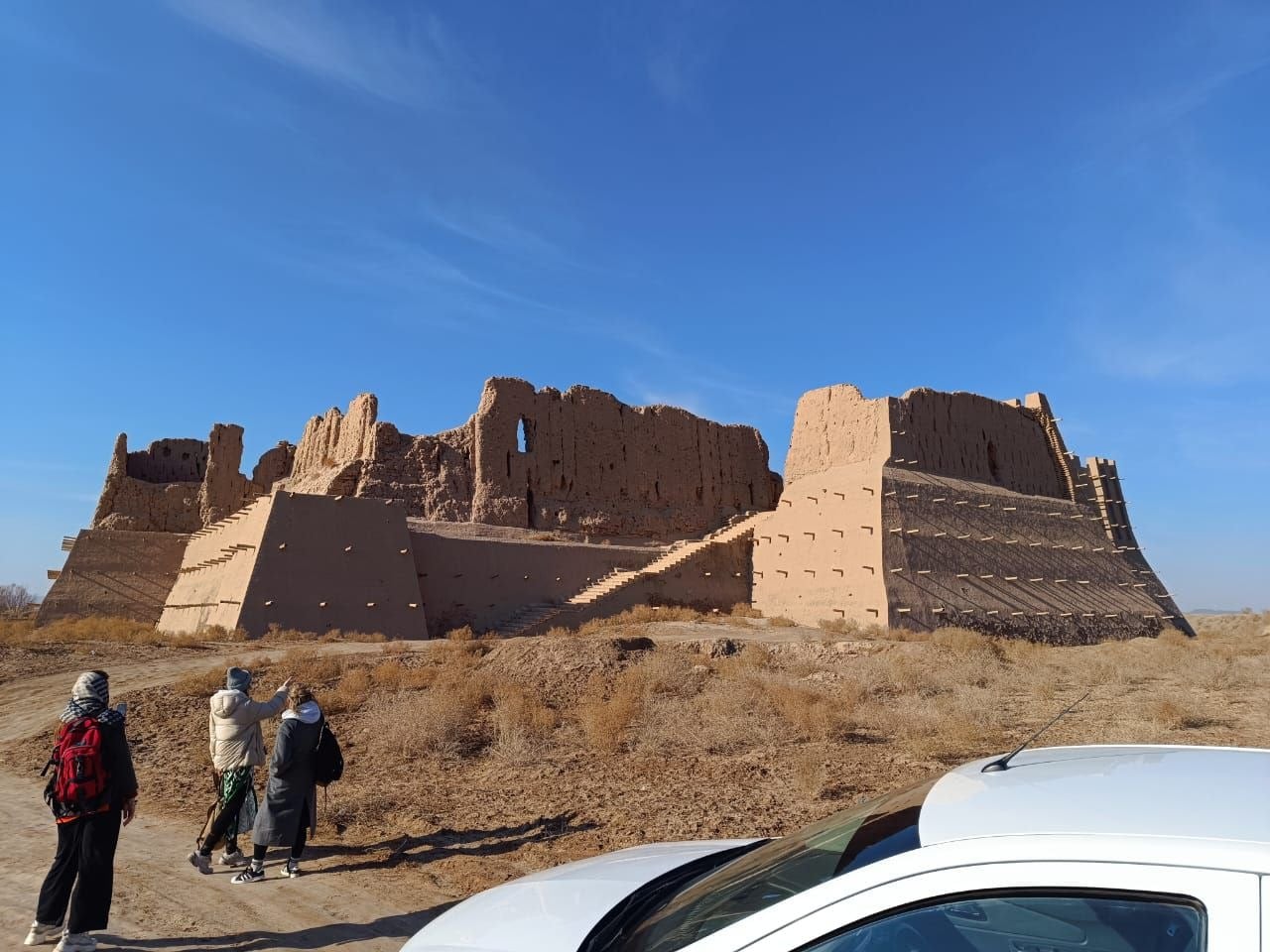
Toprak Kala (“Earth Fortress”) is the most important of the three, and the one that gives you the clearest sense of ancient royal power. It is the ruin of a walled royal city and palace that dates from the early centuries AD, when Khorezm was a strong and wealthy kingdom.
What to expect:
- Scale. The outer walls enclose a large rectangular area, and inside you can still make out the layout of streets, towers and the great palace complex on its raised platform. The mud-brick is eroded, but the footprint is easy to read.
- Rooms with a story. Excavations here found halls decorated with wall paintings and clay sculptures, and rich archives of documents written in the old Khorezmian script. Those finds are why the site is so famous among archaeologists.
- Silence. There is rarely anyone else here. You walk on old fired bricks and shards of pottery, and the wind carries the only sound.
A tip: climb up onto the highest part of the palace platform. From there, the whole plan of the city opens beneath you, and you realise how big and organised the place once was.
Because Toprak Kala is far from the road, the drive across the desert is part of the experience. Allow time to just stand and look.
Kyzyl Kala: the “Red Fortress”
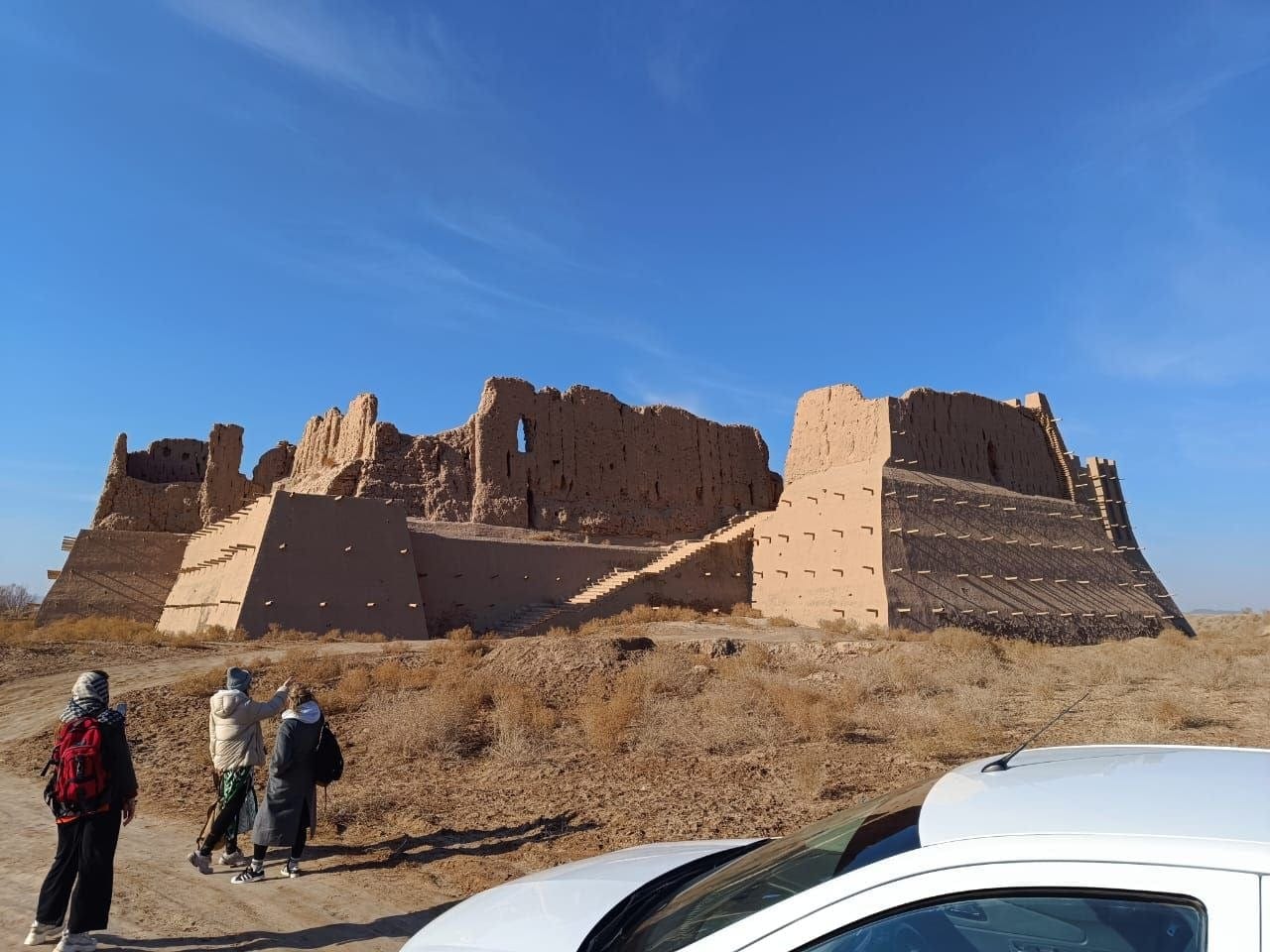
Kyzyl Kala means “Red Fortress”, and as you approach you see why: the walls glow a warm rust colour in the low sun. It is a large mud-brick fortress rising out of completely flat desert, and many travellers think it is the most photogenic of the three.
The walls are tall, with the typical ribbed, fluted look of Khorezmian military architecture, and you can still see the towers and the line of the ramparts. Walking around the outside is as good as going in. The shapes against the sky, with nothing else in view, are what you will remember.
How to enjoy it:
- Go around the outside first, then climb up into the interior and look back at the surrounding emptiness.
- Bring a wide lens or a good phone camera. The geometry of the walls is the subject.
- Come in good light. Early or late in the day the colours are deepest; at noon in summer the bricks bleach out and the heat is fierce.
Kyzyl Kala is also a good reminder of how the oasis once looked: this was not always empty land. These walls once stood among fields and canals.
Ayaz Kala, Toprak Kala & Kyzyl Kala in one day
Your own car and driver, a flexible plan and hotel pick-up. The driver waits at every fortress.
- ✓Sedan from $80, minivan from $120 for the whole car
- ✓Hotel pick-up and drop-off in Khiva
- ✓Choose your date, we confirm within hours
Ayaz Kala: three fortresses and a sunset
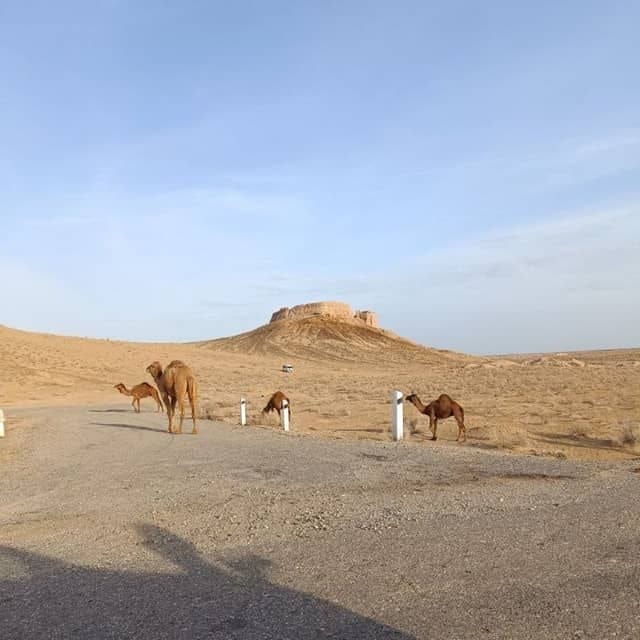
Ayaz Kala is really a group of three fortresses that watch over the desert from the edge of the Kyzylkum. The best known sits on a hilltop, with a second fortress on the plain below it, and from the walls you look out over a vast sweep of sand and the green line of the oasis far away.
Things that make it special:
- The setting. Of the three sites in this guide, Ayaz Kala has the most dramatic position. The hilltop fortress rises straight out of the desert, and the views from the ramparts are huge.
- Different ages in one place. The fortresses were built and used over a very long period, roughly a thousand years in total, so walking between them is like moving through time.
- Sunset and sunrise. Many travellers stay in the yurt camps near the foot of the hill and climb up for the golden hour, with the wall catching the last light.
You can walk up the hill in a short, steady climb. Wear proper shoes: the path is loose and rocky in places.
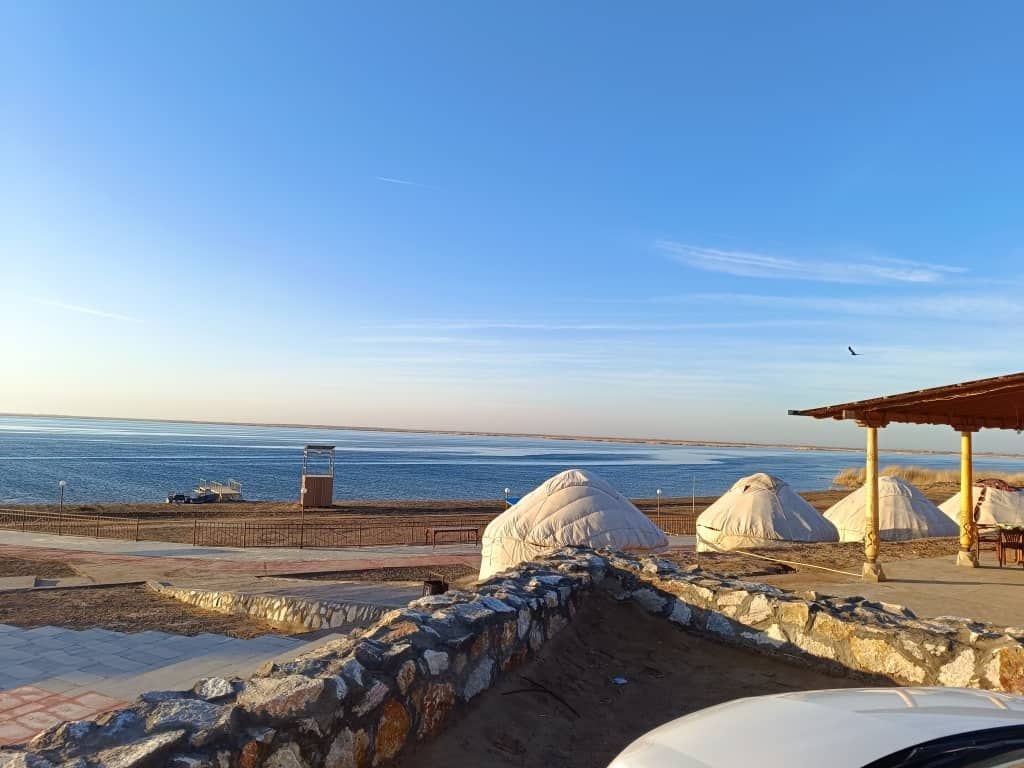
If you want more than a day trip, ask us about an overnight in a yurt camp nearby. It turns a long day into a slower, more atmospheric experience, and our 2-day Aral Sea tour includes a night in the desert and can be combined with these sites on request.
How the day trip from Khiva works
The classic way to see all three is a private one-day trip from Khiva, and it follows a simple rhythm:
- Early pick-up at your hotel in Khiva. We recommend a morning start: it is cooler, the light is better and you will not be rushed.
- A drive across the oasis and into the desert. Part of the pleasure is watching the farmland thin out and the landscape open up.
- The first fortress while the light is soft. Walk the walls, climb to the viewpoints, take your time.
- A lunch break on the road. Lunch is not included, and your driver will stop somewhere simple and local.
- The remaining fortresses in the afternoon. Two more sites, at your own pace. This is the time for photographs.
- The drive back with the desert at golden hour, and drop-off at your hotel in the late afternoon or early evening.
It is a full day, not a half day, because the sites are far apart and the distances in the desert are real. The exact start time depends on the season, and we confirm it with you when you book.
The trip is driver-led: your driver knows the roads and the order of the sites, and waits while you explore. If you would like the history explained as you walk, we can add an English-speaking guide on request.
When is the best time to go?
You can visit all year, but the experience changes a lot with the seasons:
- Spring (April to May) and autumn (September to October) are the best. The days are warm without being punishing, the light is soft and the walking is comfortable.
- Summer (June to August) is very hot in the desert, and there is almost no shade. If you go in summer, start at first light, finish the walking before midday, drink a lot of water and cover your head.
- Winter (November to March) is cold, the days are short and the wind can bite, but the ruins are almost empty and the low sun is wonderful for photography. Dress in layers and plan around daylight.
A useful rule of thumb: the further from midday you walk, the better the experience. Early morning and the last hours before sunset are best in every season.
 Two days?
Add the Aral Sea and a night in a yurt
The 2-day tour reaches Moynaq's ship graveyard, the Aral shore at sunset and a desert yurt camp.
- ✓Private car and 4×4
- ✓Night in a yurt, dinner and breakfast
- ✓One price for the whole group
What to bring and how to avoid the common mistakes
Most problems on this trip are easy to avoid:
- Closed, grippy shoes. Ruins mean loose sand, uneven bricks and short climbs. Sandals are a mistake.
- Water, a hat and sun protection. There is almost no shade at the sites. Bring a litre or two per person.
- A light scarf. It keeps the sun and the dust off your neck and face, and it looks great in photos.
- Cash for tickets and lunch. Entrance fees are paid on the spot, usually in cash. They are not included in the price, and your driver can tell you the current amount.
- A charged phone and a power bank. You will take more photos than you expect, and signal can be patchy.
- Patience for the drive. The journey is part of the experience. Download music or a podcast, and enjoy the view.
And two small mistakes to avoid: do not climb on fragile walls, and do not take pottery fragments or bricks as souvenirs. These sites are protected, and they are fragile.
Can you get there without a private driver?
In practice, no. These fortresses are far from towns, far from each other and far from the main roads, and public transport does not serve them. Shared taxis can take you to nearby towns, but not to the sites themselves, and the final stretch is often on desert tracks.
That is why almost every visitor goes with a private car and driver. A driver who knows the roads can link the three sites in one day, wait while you walk, choose a sensible lunch stop and get you back to Khiva before dark. It is also usually cheaper per person than you expect, because the price covers the whole vehicle. For a small group, the cost per person falls quickly as the car fills up.
How to combine the fortresses with the rest of your trip
The fortresses fit neatly into a Khorezm itinerary:
- With Khiva. Spend a day inside the walled city of Itchan Kala and a day among the desert fortresses. Together they tell the whole story, from ancient Khorezm to the medieval khanate.
- With Nukus and the Savitsky Museum. Karakalpakstan has another world-class highlight, the museum known as the Louvre of the desert. See our guide to Nukus, the Savitsky Museum and Mizdakhan, or book the Nukus day trip from Khiva.
- With the Aral Sea. If you have two days, the 2-day Aral Sea tour adds Moynaq, the shore and a night in a yurt. Read the Moynaq ship graveyard guide for the full story.
- On the way between cities. If you are travelling from Bukhara to Khiva, our guide to the desert fortresses route by private car shows what you can see on the road.
Ready to go?
from $80 per car
Book your Khorezm fortresses day trip
Private, flexible and priced per car. Tell us your date and group size and we confirm quickly.
How much does it cost?
The day trip is priced per vehicle, not per person, so the more of you share, the less each person pays:
- Sedan (1 to 3 people): $80 for the whole car
- Minivan (4 to 7 people): $120 for the whole car
With a full minivan, that works out to well under $20 per person. The price includes the private car with driver for the whole day, fuel and hotel pick-up and drop-off in Khiva.
Not included (paid on the spot): entrance tickets to the sites, lunch and drinks, tips, and a guide if you want one.
Because this is a private trip, you can choose your date, and we confirm the start time and the plan when you book. Prices on the trip page are always the current ones: check the date and book here.
Часто задаваемые вопросы
What are the desert fortresses of Khorezm?
They are ancient fortified sites in the Ellik-Kala region of Karakalpakstan, built by the Khorezm civilisation over roughly a thousand years. The best known are Ayaz Kala, Toprak Kala and Kyzyl Kala.
How do I get to Ayaz Kala, Toprak Kala and Kyzyl Kala from Khiva?
The practical way is a private car and driver on a full-day trip from Khiva. There is no public transport to the sites, and the final stretch is on desert roads.
How long does the fortress day trip take?
Plan on a full day. The sites are far from Khiva and from each other, so a large part of the day is the drive. We confirm the start time when you book.
Which fortress is the best one to see if I only have time for one?
Toprak Kala is the most important historically, with the layout of a royal palace city. Ayaz Kala has the most dramatic setting, and Kyzyl Kala is the most photogenic. The day trip combines all three.
What is the best time of year to visit?
Spring (April to May) and autumn (September to October) are best. Summer is very hot, winter is cold, but the ruins are quiet in both.
How much does the day trip cost?
A sedan for up to 3 people costs $80 and a minivan for up to 7 people costs $120. The price is for the whole vehicle. Entrance tickets and lunch are paid on the spot.
Do I need a guide?
No. The trip is driver-led, and many travellers explore on their own. If you want the history explained, ask us to add an English-speaking guide.
Is it suitable for children and older travellers?
Yes, with some care. The drive is long, and the sites involve walking on uneven ground and short climbs. Tell us the ages and mobility of your group and we will plan the pace.
Can I stay overnight in a yurt near the fortresses?
Yes. There are yurt camps near Ayaz Kala. Ask us and we will plan an overnight, or look at our 2-day Aral Sea tour that includes a night in the desert.
Are the fortresses free to enter?
No. Entrance fees apply and are paid on the spot, usually in cash. They are not included in the price of the trip.
Can I take photographs and use a drone?
Photography is welcome and is the highlight for many visitors. Drone rules in Uzbekistan are strict, so check them before you bring one.
Автор
TourFixer Team
Uzbekistan Travel Experts