Everything about Qovun Sayli (also searched as Kovun Sayli or Wovun Sayli), Uzbekistan's annual melon festival in Khiva — confirmed 2026 dates, what actually happens there, and the real, practical way to get to Khiva for it.
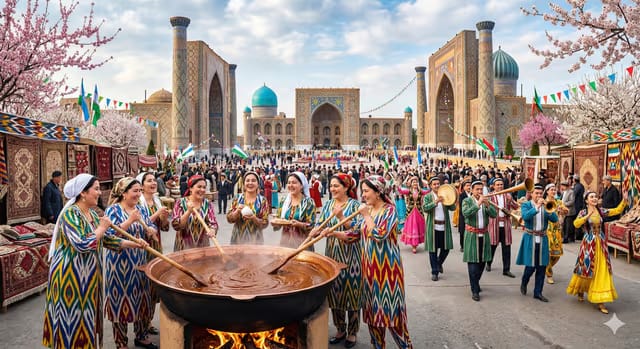
Once a year, the ancient walled city of Khiva turns its main squares into an open-air celebration of the one crop the Khorezm region is most famous for: melons. Qovun Sayli — literally "melon festival" in Uzbek, and also commonly searched as Kovun Sayli or Wovun Sayli depending on how the Uzbek "Q" sound gets transliterated — is a real, government-organized event held inside and around the Ichan-Kala old town.
This guide covers exactly what the festival is, the confirmed 2026 dates and venues, what actually happens on the ground, and — since Khiva is genuinely awkward to reach without planning — the practical, honest ways to get there for it.
Quick Answer: The Essentials
| Question | Answer |
|---|---|
| When is it in 2026? | August 8–10 |
| Where exactly? | Ichan-Kala and Arda Khiva complexes, Khiva, Khorezm region |
| Who organizes it? | The Tourism Committee and the Khorezm regional hokimiyat (local government) |
| Is there an entry fee? | No ticket price has been publicized — it's run as an open regional celebration |
| What's the highlight? | A closing gala concert on August 10 with local and international performers |
| Nearest airport? | Urgench International Airport, about 35 minutes from Khiva |
| Is this the same as Turkmenistan's "Melon Day"? | No — that's a separate, unrelated national holiday in a different country. See below. |
Flying in for the Festival?
Urgench Airport → Khiva — from $30
Khiva has no airport of its own — everyone lands in Urgench. Book your 35-minute transfer straight into the old town.
from $30 / whole car $30
Book Airport TransferWhat Qovun Sayli Actually Is
Khorezm's melons have long carried a strong reputation in Central Asia — the region's dry heat, long summer days, and irrigation from the Amu Darya river basin produce melons that locals and visiting traders have prized for generations. Qovun Sayli formalizes that pride into an annual public festival: growers and districts from across the Khorezm region bring their harvest into Khiva to display and compete, and the old town becomes the stage for a broader cultural celebration built around it.
The name itself comes directly from Uzbek: qovun means "melon," and sayli means "festival" or "outdoor celebration." Because Uzbek's "Q" doesn't map cleanly onto English spelling conventions, you'll see the same event written as Qovun Sayli, Kovun Sayli, and Wovun Sayli across different sites and social posts — they all refer to the identical festival.
Not to Be Confused With Turkmenistan's "Melon Day"
If you search in English, you may also come across "Melon Day" — a completely separate national holiday in neighboring Turkmenistan, held every year on the second Sunday of August in Ashgabat, established in 1994. It celebrates a specific Turkmen melon variety and has its own history, its own government, and its own venue hundreds of kilometers away. Qovun Sayli in Khiva, Uzbekistan is a distinct regional event — don't let the similar concept and timing confuse the two when you're planning a trip.
2026 Dates, Venues & Organizers
The 2026 edition of Qovun Sayli runs Friday August 8 through Sunday August 10, at two venues in Khiva:
- Ichan-Kala — the walled inner city and UNESCO World Heritage core of Khiva, where most of the exhibition and performance activity takes place among the madrasahs and minarets.
- Arda Khiva — a complex just outside the old town, used for additional festival space.
The event is organized jointly by Uzbekistan's Tourism Committee and the Khorezm regional hokimiyat (provincial government), explicitly as a tourism-promotion initiative for the region — meaning it's built with visitors, not just locals, in mind.
Because this is an annual event, expect it to recur around the same window in future years, though exact dates should always be reconfirmed closer to your travel date since regional festivals in Uzbekistan can shift by a week or two year to year.
What Actually Happens: The Program
Based on official coverage of the 2026 event, the program includes:
- A melon exhibition-fair — cities and districts across the Khorezm region bring their harvest to display and compete, showing off local varieties grown specifically in the region's soil and climate.
- Theatrical performances and puppet shows — staged throughout the festival days, often woven into the old-town setting itself.
- National costume displays — regional and historical Khorezm dress, shown as part of the broader cultural program.
- Traditional food exhibitions — regional dishes alongside the melon displays.
- Handcrafted goods and master classes — local artisans selling and demonstrating traditional crafts.
- Folklore group performances — live regional music and dance throughout the grounds.
- A closing gala concert on August 10 — featuring both local and international performers, capping off the three days.
Prizes are also awarded by the Khorezm hokimiyat and sponsors to active participants across several categories, which is part of why growers travel in from across the region to take part rather than just sell locally.
How to Actually Get to Khiva for the Festival
This is the part most festival write-ups skip, and it matters: Khiva itself has no airport or train station — both sit in Urgench, about 35 km away. How you get there depends entirely on where you're starting from.
Flying in for the festival
If you're flying specifically for Qovun Sayli, you'll land at Urgench International Airport, then need a short onward transfer into Khiva. This is a 35-minute, 44 km hop — book it in advance for festival dates, since local taxi availability tightens up when a regional event pulls in extra visitors.
Coming from Bukhara
Most Silk Road itineraries reach Khiva from Bukhara, and this is a real driving stretch: 522 km, roughly 4.5–5.5 hours by private car. There's no direct train between Bukhara and Khiva outside of the new high-speed express (which only runs three days a week — see our night trains guide for the full schedule), so most travelers on this leg go by private car.
Coming from Samarkand
Samarkand to Khiva is a longer haul — 796 km, roughly 8.5–9.5 hours by road. Most travelers on this route either break the drive into stages (via Bukhara) or fly into Urgench separately and treat Khiva as a standalone leg of the trip.
Coming from Tashkent
If Tashkent is your starting point, you have more structured options than the Bukhara/Samarkand legs: the Jaloliddin Manguberdi high-speed express covers Tashkent to Khiva in about 7.5 hours, but only on Tuesdays, Thursdays, and Saturdays — check whether that lines up with the festival dates before relying on it. There's also the overnight sleeper train, which runs daily but takes 14–16 hours. For a full breakdown of every option on this specific route, see our dedicated Tashkent to Khiva transport guide.
Coming from Bukhara?
from $120 / whole car $120
Bukhara → Khiva Private Transfer — from $120
522 km, one straight private ride, hotel to hotel — no station transfers on either end.
Coming from Samarkand?
Samarkand → Khiva Private Transfer — from $170
796 km door-to-door — skip the multi-stage logistics and book one private car straight to Khiva.
from $170 / whole car $170
Book Samarkand → KhivaPractical Tips for Visiting
Weather
Early-to-mid August in Khorezm is genuinely hot — daytime temperatures regularly climb into the high 30s°C (upper 90s°F). Plan outdoor time for morning or early evening, carry water, and expect the old town's stone surfaces to hold heat well into the night.
What to bring
- Light, breathable clothing and sun protection — the festival activity is largely outdoors
- A camera — the combination of Ichan-Kala's architecture and festival costumes/performances is genuinely photogenic
- Small cash (som) for craft purchases and food stalls, since card acceptance at informal festival stalls can be inconsistent
Timing your visit within the festival
The closing gala concert on August 10 is the single highest-energy moment, but it also means the old town will be at its most crowded that evening. If you'd rather see the melon exhibition and craft stalls without a crowd, earlier in the festival (August 8) and daytime hours tend to be calmer.
Combine it with the rest of your trip
Khiva already sits at one end of the classic Tashkent–Samarkand–Bukhara–Khiva Silk Road circuit. If you're timing a trip around the festival, it's worth treating Khiva as the natural finishing point of that route rather than a standalone destination — see our Bukhara to Khiva road trip stops guide for what to see along the way.
Часто задаваемые вопросы
What does "Qovun Sayli" mean, and why is it also spelled Kovun Sayli or Wovun Sayli?
Qovun Sayli is Uzbek for "melon festival" (qovun = melon, sayli = festival/outdoor celebration). The variant spellings Kovun Sayli and Wovun Sayli are simply different attempts to transliterate the Uzbek "Q" sound into English — all three refer to the exact same event.
When is Qovun Sayli in 2026?
The 2026 festival runs August 8–10, at the Ichan-Kala and Arda Khiva complexes in Khiva, Khorezm region. As an annual event, expect a similar window in future years, but reconfirm exact dates closer to your travel.
Is Qovun Sayli the same as Turkmenistan's "Melon Day"?
No. Turkmenistan's Melon Day is a separate national holiday, always on the second Sunday of August in Ashgabat, established in 1994 to celebrate a specific Turkmen melon variety. Qovun Sayli in Khiva, Uzbekistan is a distinct regional festival in a different country, run by different organizers.
Is there an entry fee for Qovun Sayli?
No ticket price has been publicized for the festival — it's organized by the Tourism Committee and Khorezm regional government as an open public celebration.
What actually happens at the festival?
A melon exhibition-fair from growers across the Khorezm region, theatrical and puppet performances, national costume displays, traditional food and craft stalls, folklore performances, master classes, and a closing gala concert on the final day featuring local and international performers.
What's the best way to get to Khiva for the festival?
It depends where you're starting. Flying into Urgench International Airport and taking a 35-minute transfer into Khiva is the most direct route. From Bukhara it's about 522 km (4.5–5.5 hours) by private car; from Samarkand about 796 km (8.5–9.5 hours). From Tashkent, the Jaloliddin Manguberdi express train covers it in 7.5 hours but only three days a week.
Does Khiva have its own airport?
No. Both the airport and train station serving Khiva are located in Urgench, about 35 km (roughly 35 minutes by car) away.
Is August too hot to visit Khiva?
It's genuinely hot — daytime temperatures regularly reach the high 30s°C. It's manageable with normal precautions (sun protection, water, planning outdoor time for morning or evening), but it's worth knowing before you go.
Can I combine Qovun Sayli with the rest of a Uzbekistan trip?
Yes — Khiva sits at one end of the classic Tashkent–Samarkand–Bukhara–Khiva Silk Road route, so most visitors treat the festival as the finishing point of a broader circuit rather than a standalone trip.
When during the festival is least crowded?
The closing gala concert on the final day (August 10 in 2026) draws the biggest crowds. Earlier in the festival and daytime hours are calmer if you'd rather see the melon exhibition and craft stalls without a crowd.
Who organizes Qovun Sayli?
Uzbekistan's Tourism Committee, together with the Khorezm regional hokimiyat (provincial government), organize the festival explicitly as a regional tourism initiative.